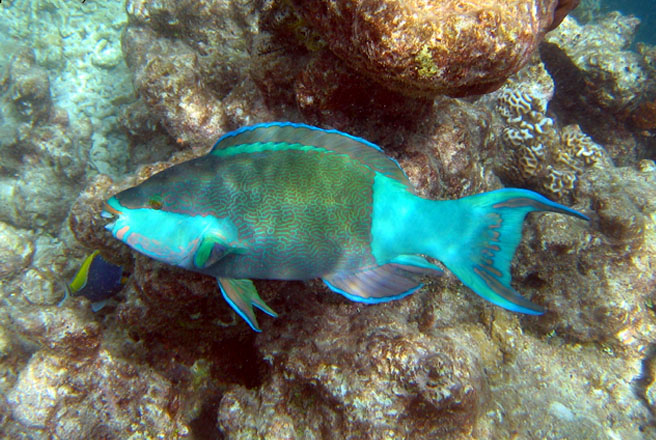
About 95 species of brightly coloured reef fish whose teeth are fused into a parrot-like beak, most diverse in the Indo-Pacific. They scrape algae from coral and rock, grind it up and excrete the rest as sand. Most start life as females and later change into males.
Quick answers
What is it?Fish
Carnivore?No, herbivore
Dangerous?No
Domesticated?No
Awake when?Daytime
Hibernates?No
Kept as a pet?No
Do people eat it?In places
Larger species are fished commercially, mainly in the Indo-Pacific, but most species are not heavily fished.
At a glance
Found inOceans
HabitatCoast
ColoursBlue, Green, Pink
SizeMedium
LengthMostly 30–50 cm; green humphead up to 1.3 m
LegsNone
Covered inScales
Lives ingroups
Lives for5–20 years
Can swim
Lays eggs
In the wild
- Where it lives
- Coral reefs, rocky coasts and seagrass beds; most species live in the Indo-Pacific.
- What it eats
- Algae scraped from coral and rock, dead coral and rubble, seagrass, and sometimes live coral.
Did you know
It grinds coral into sand: one humphead parrotfish can make 90 kg of sand a year.
Some wrap themselves in a mucus cocoon at night, probably to hide their scent from predators.
Early scientists named more than 350 species, almost four times the real number, because the colour phases look so different.
Often confused with
- Wrasse
Parrotfish are now classed inside the wrasse family; their teeth are fused into a parrot-like beak for scraping algae.
Compare side by side
On these lists
Sources
Last reviewed
Play
Could you have guessed it?
A photo, a few hints, one guess. Same 438 animals.
